
Australia's Sales Role Play Training Gap, Explained
3 September 2026 · 7 min read

Australian contact centres say coaching is the most important thing a team leader does — then structurally deny them the time to do it. New sector benchmarking from ACXPA found that 53% of Australian contact centres run no structured development program at all, which means much of the sector's skill-building happens live, on real customers, rather than in rehearsal beforehand.
What the ACXPA benchmarking actually found
The 2026 Australian Contact Centre Best Practice Report, published by the Australian Customer Experience Professionals Association (ACXPA), surveyed team leaders across the local contact centre sector on how they spend their time and what they believe matters most.
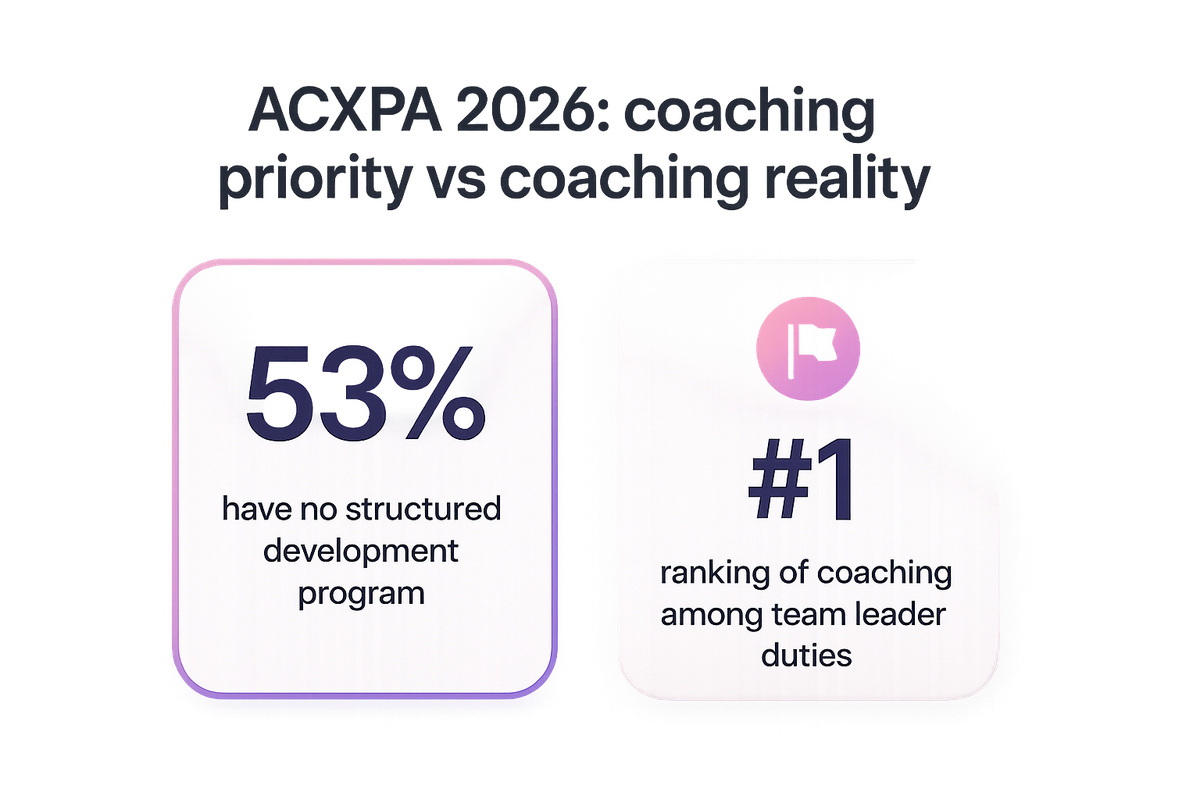
The headline finding is a straightforward contradiction:
- Coaching and development was ranked by team leaders as their single most important duty.
- Yet 53% of centres surveyed have no structured development program in place.
- The gap isn't a values problem — leaders know coaching matters. It's a delivery problem.
When there's no formal program, coaching doesn't disappear. It just moves. It shifts from scheduled, low-stakes rehearsal to whatever a rep can pick up mid-call, under a real customer's patience.
Why coaching keeps losing to the roster
If Australian team leaders genuinely rate coaching as priority one, why does it keep slipping? ACXPA's research points to a structural answer rather than an attitudinal one: escalations, rostering and day-to-day coordination absorb the hours that would otherwise go to development.
This matches a pattern seen in global sales-coaching research, cited here only as comparative context rather than Australian evidence. Capacity modelling from CuePitch (2026) estimates that a sales manager with 12 direct reports, once admin, pipeline management and forecasting are accounted for, may have only around 90 minutes of genuine one-on-one coaching time per rep, per week. That's not a discipline failure. It's arithmetic.
Australian team leaders are almost certainly running the same equation, just with escalations and shift rosters in place of pipeline reviews.
What happens when rehearsal moves to game day
When structured practice time doesn't exist, the first live customer interaction of the week often doubles as the rehearsal. That has a measurable cost, according to global benchmarks offered here as directional context rather than local findings.
MySalesCoach (2026) reports that teams coached weekly hit quota 76% of the time, a figure that falls to 56% at a monthly coaching cadence and 47% at quarterly or less — a 29-point swing tied directly to how often structured coaching actually happens. Separately, Kendo AI (2026) puts the average share of a rep's working week spent actually selling at around 28%, which underlines how little unstructured time is realistically left over for deliberate, repeated practice before it counts.
No Australia-specific, sales-only benchmark of this kind currently exists — the ACXPA contact centre data remains the strongest local anchor for this argument. But the underlying mechanism (limited manager time, competing priorities, practice happening live instead of beforehand) is one Australian leaders will recognise regardless of which numbers they're working from.
The manager-rep perception gap
Even where coaching does happen, it may not land the way managers assume. CuePitch (2026) found that 90% of sales managers report coaching their reps at least monthly — but only 62% of reps agree that it's happening. The same research found 93% of managers rate their own coaching quality as high, compared with just 68% of reps.
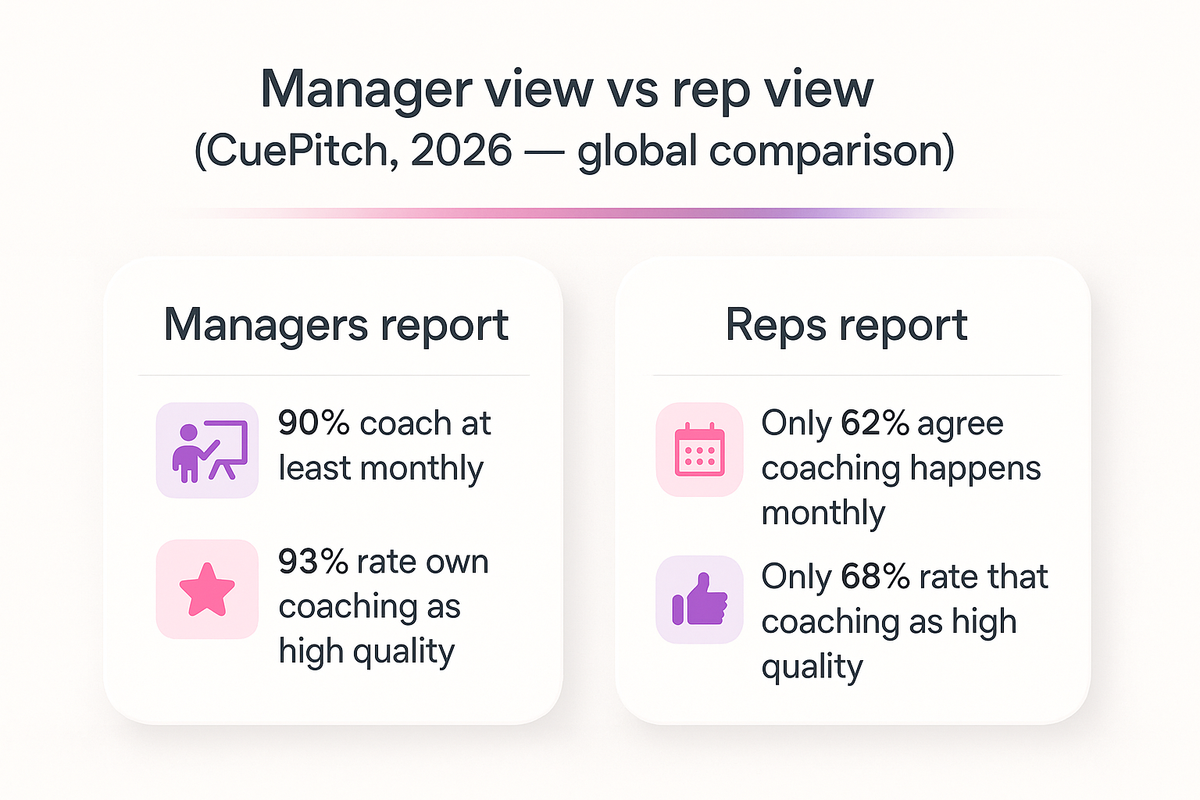
That gap suggests two separate problems worth separating out for Australian teams: how often coaching happens, and whether it's structured well enough for reps to actually experience it as coaching, rather than a quick debrief squeezed between calls.
Where scalable rehearsal could actually fit
The honest reason coaching keeps losing to the roster is that traditional rehearsal is expensive to run well. Booking a role-play partner, briefing a facilitator, or scripting a realistic scenario for every product, objection or de-escalation situation takes time most team leaders don't have — which is exactly why practice quietly defaults to "the next real call."
That's the specific bottleneck newer AI-generated rehearsal tools are built to remove. Platforms such as Nova (https://nova.supahuman.com) can generate contextual, role-specific role-play and simulation scenarios in minutes rather than weeks, letting a rep run a difficult objection or an angry-customer scenario repeatedly, with feedback, before it ever happens live. That doesn't replace a team leader's coaching — it gives reps something to rehearse with when the leader's 90 minutes a week has already gone to rostering and escalations.
For Australian sales and service leaders, the reframe worth taking from ACXPA's findings is this: the coaching shortfall isn't about caring less. It's a capacity and design problem, and one that scalable, role-specific rehearsal — rather than more manager hours nobody has — is the more realistic fix.
Key takeaways
- ACXPA's 2026 Australian Contact Centre Best Practice Report found 53% of Australian contact centres have no structured development program, despite team leaders ranking coaching as their top duty.
- Escalations, rostering and coordination work are the specific things crowding coaching out of team leaders' weeks, according to the same report.
- Global research (CuePitch, MySalesCoach, Kendo AI — cited as comparison, not Australian data) links coaching frequency directly to quota attainment and shows a persistent perception gap between what managers believe they deliver and what reps experience.
- Manager-capacity modelling suggests roughly 90 minutes of one-on-one coaching time per rep, per week, is the realistic ceiling once other duties are accounted for — a structural constraint, not a motivational one.
- Scalable, contextual rehearsal tools are one practical way to give reps repeated, low-stakes practice without requiring more of a team leader's already-committed hours.
Our take
The ACXPA finding is worth sitting with because it removes the easiest excuse: this isn't a sector that doesn't value coaching. It's a sector whose own leaders say coaching matters most, then structurally can't deliver it — which means more training on coaching skills won't fix it. What's missing is capacity, and capacity problems need a design solution, not a discipline lecture. Australian sales and service leaders who treat rehearsal as something that has to be scheduled into an already-full team leader's calendar will keep losing that fight to the roster. The more durable answer is probably to decouple practice from manager availability altogether, so reps can rehearse the scenario that's actually coming up for them before they're standing in front of it live.
FAQ
What is the rehearsal gap in Australian sales and service teams? It refers to the disconnect between how much structured, low-stakes practice reps get before real customer interactions and how much coaching happens live, on the job. ACXPA's 2026 Australian Contact Centre Best Practice Report found 53% of Australian contact centres have no formal development program, despite team leaders ranking coaching as their top priority.
Why don't more Australian contact centres have structured coaching programs? According to ACXPA's research, it's largely a time and workload issue rather than a lack of intent. Escalations, rostering and day-to-day coordination absorb the hours team leaders would otherwise put toward coaching and development.
Is the coaching gap unique to Australia? No equivalent Australia-only, sales-specific benchmark currently exists beyond the ACXPA contact centre data, but global research from CuePitch and MySalesCoach (2026) shows a similar pattern internationally — a gap between how much coaching managers believe they deliver and how much reps say they receive.
Does more frequent coaching actually change outcomes? Global benchmarking cited here as comparative context (MySalesCoach, 2026) links weekly coaching cadence to a 76% quota attainment rate, versus 56% at monthly cadence and 47% at quarterly or less — a 29-point difference. No equivalent Australian figure has been published yet.
How can Australian teams close the coaching capacity gap without hiring more managers? Giving reps a way to rehearse role-specific scenarios independently — through AI-generated role play, simulations or coached practice tools such as Nova — lets practice happen without needing every session to compete for a team leader's limited one-on-one time.